
Signal
PDM vs PIM vs DAM: Most Catalogs Break at the Handoff
Stephan Spijkers · 2026-11-03 · 7 min read
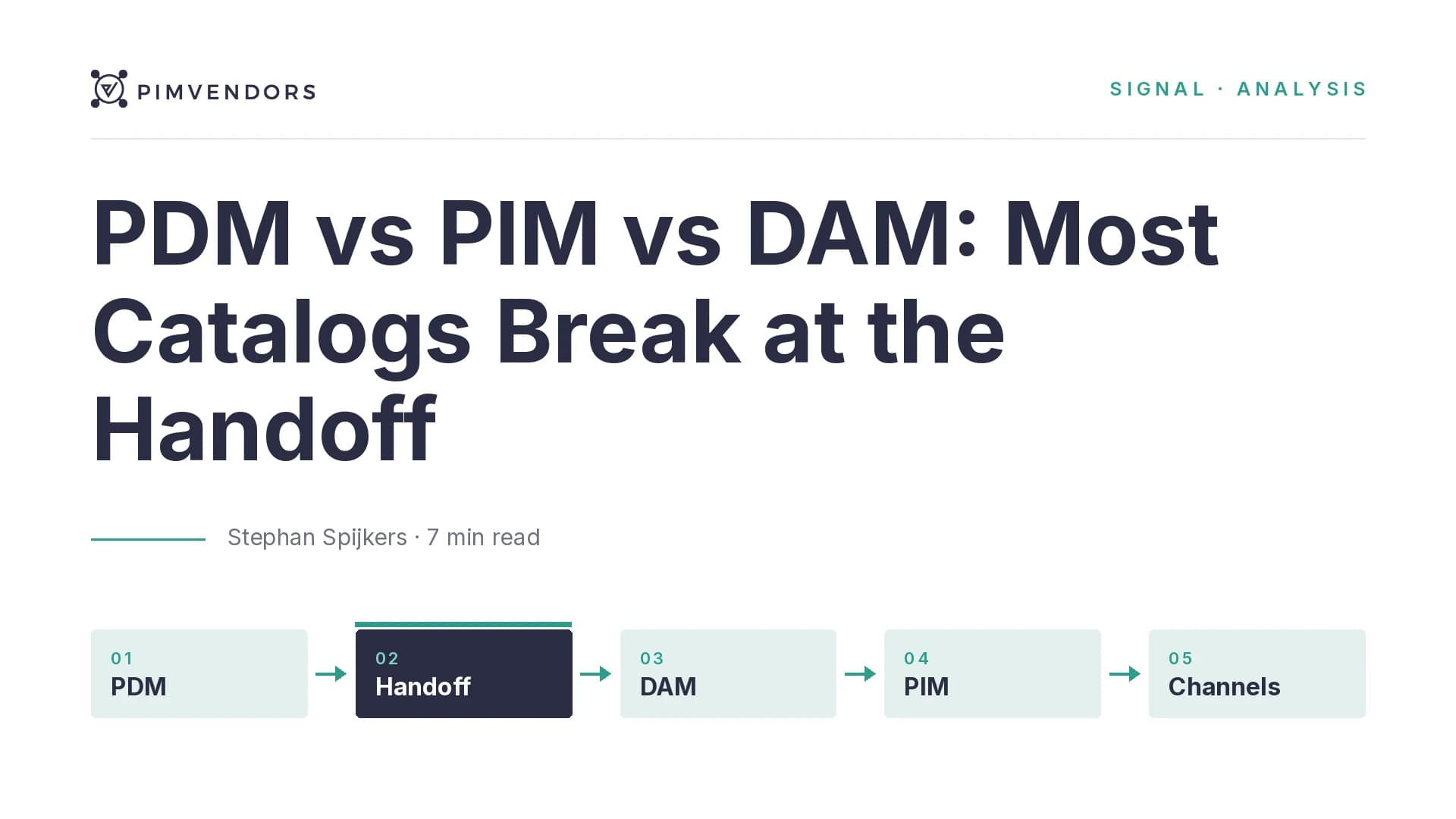
PDM owns how a product is engineered, PIM owns how it is described and sold, and DAM owns the files that represent it. The three systems rarely compete with each other. The failures happen between them, at the moment a released engineering value has to become a commercial attribute, or a CAD export has to become a product image or a datasheet. That handoff decides whether the webshop, the distributor feed and the datasheet agree with what the factory actually builds.
Crystallize drew the same split in PDM vs PIM vs DAM: who owns product data before and after it goes to market, published on 29 October 2026 by Magnus Nambord and Nebojsa Radakovic. It is one of the clearest recent vendor explanations of where engineering truth ends and commercial truth begins, so read it for the definitions. This article picks up the point the Crystallize authors call the expensive bit, the handoff itself, and what it takes to keep it from breaking.
Three systems, three owners
PDM is an engineering system. It manages CAD models, drawings, bills of materials, revisions and approval states, and it records which version of a product is approved. Crystallize names SOLIDWORKS PDM and Autodesk Vault as examples. PIM is a commercial system. It holds sellable variants, specifications in the units a market expects, descriptions, translations, categories and channel attributes. DAM governs files such as images, videos, PDFs, design exports and brand assets, together with their versions and usage rights.
Our guide to what PDM is covers the engineering side in depth, from check-in and check-out to the different views of a bill of materials. Read it when the question is what a PDM system stores and why engineers depend on it. DAM and PIM systems explains the split between files and product facts. Open it when you are deciding whether media needs a separate DAM.
| PDM | PIM | DAM | |
|---|---|---|---|
| Owns | The approved technical definition | The sellable product record | Files and their usage rights |
| Typical content | CAD models, drawings, BOM, revisions | Specifications, variants, copy, translations, channel attributes | Images, video, PDFs, design exports |
| Main users | Engineering and production | Product, marketing and e-commerce teams | Marketing, creative and brand teams |
| Records | Which version is released | What a buyer or channel needs to know | Which file may be used where |
Where the handoff breaks
Some facts cross from PDM into PIM: dimensions, materials, weights, performance values and certificates. Crystallize illustrates this with an industrial pump. The PDM knows its CAD assembly, tolerances and BOM, and the PIM knows its sellable SKU, flow rate, operating temperature, compatible fittings and localized copy. The flow rate starts life in engineering and ends up on a product page, in a marketplace feed and in a printed catalog.
The catalog breaks when that value is retyped instead of passed on. Someone exports a specification sheet, copies the numbers into the PIM, and from that moment two versions exist. The next engineering change updates one of them. Nobody notices until a distributor sells a pump with last year's operating range, or a customer orders a part that no longer fits the current revision. The Crystallize authors put it plainly: a manual copy in the PIM is a second truth that slowly becomes less truthful.
A manual handoff tends to lose three things at once. The release state disappears, so the PIM cannot tell a released value from a draft. The revision link disappears, so the product page no longer shows which version of the product it describes. And the unit or format shifts on the way, because engineering stores millimetres and newtons while a channel expects inches or a rounded display value. Each of these is a data model question as much as an integration question. The product data model is where you decide which attributes carry a source, a unit and a revision, and that decision belongs before the connector is built.
The release is the contract
The handoff holds when engineering release is the trigger and every attribute that crosses has exactly one owner. A value that originates in PDM is read-only in the PIM. Marketing adds context around it, such as the text that explains what a flow rate means for an installer, without touching the number itself. When engineering releases a change, the new value replaces the old one in the PIM and reaches every channel with the next publication. Crystallize describes this as a controlled handoff, in which marketing adds context "without quietly changing physics".
Our guide to PLM and PIM integration walks through the touchpoints and the attribute ownership in detail, with a worked example of a machine builder. Read it when you are scoping the connection itself. Product data quality and governance covers the approval rules that keep the PIM side consistent once the data has landed. Open it when you have to settle who may edit which field.
Where DAM sits
DAM is not a stage between PDM and PIM. It runs alongside both. Assets can start in engineering, as a rendering from a CAD model or an exploded drawing, or in creative production, as a lifestyle photo. They become commercial once they are linked to a product. The handoff problem applies to files in exactly the same way. A datasheet PDF generated from an old revision, or a technical drawing exported once and never refreshed, is a stale copy just like a retyped attribute. The DAM should know which product and which revision an engineering file belongs to, and the PIM should hold a link to the governed asset instead of a loose upload.
Crystallize names Bynder and Canto as specialist DAM platforms. It also states that its own Asset Organizer can remove the need for a separate DAM when media management is mainly product and commerce oriented, and that more advanced enterprise asset governance may still call for a dedicated DAM. That is a fair line to draw. Brand-wide asset governance, with usage rights and many files that belong to no product, points to a dedicated DAM. A catalog whose media consists of product images and documents can often keep them in the PIM.
What AI changes at the handoff
AI tools now extract attributes from engineering documents, map PDM terminology to a PIM schema, flag specification changes and write descriptions from approved facts. That speeds up the handoff, and it also raises the cost of a wrong source. A model that fills a missing value with something plausible produces a product page that reads well and is wrong. In the words of the Crystallize authors, if a model invents a specification instead of retrieving an approved one, "you have automated the recall notice". The safeguard is the same as without AI. The extracted value carries its source and its release state, and it is checked against the PDM before it is published. What AI inside a PIM actually does shows where these features hold up in practice and where they break.
Who needs which
A distributor that sells finished products from many suppliers rarely needs PDM. Its engineering data arrives from suppliers, and the work is onboarding, enriching and distributing that data, which is PIM work. For a distributor the supplier's datasheet plays the role the PDM plays for a manufacturer: the source the PIM reads from, and does not rewrite. A manufacturer of engineered or configurable products needs PDM for the design and PIM for the market, and the connection between the two is the project that decides catalog quality. DAM enters for both once the number of files, channels or usage rights grows beyond what the media fields in the PIM can carry.
The Crystallize comparison is the right starting point for the definitions. The work after it is to name an owner for every attribute and every file that crosses from engineering to commerce, to make the engineering release the trigger, and to stop retyping. A catalog built that way has one product with three views. A catalog that skips it ends up with three products that drift apart.
Diagnostic
Do you actually need a PIM?
Run the complexity index before you budget software or hire an SI.
Budget
Model a first-pass TCO
Translate catalog shape into a three-year cost range in under ten minutes.