
Core
censhare Alternatives: 7 PIM Solutions to Compare
Stephan Spijkers · 2026-10-11 · 9 min read
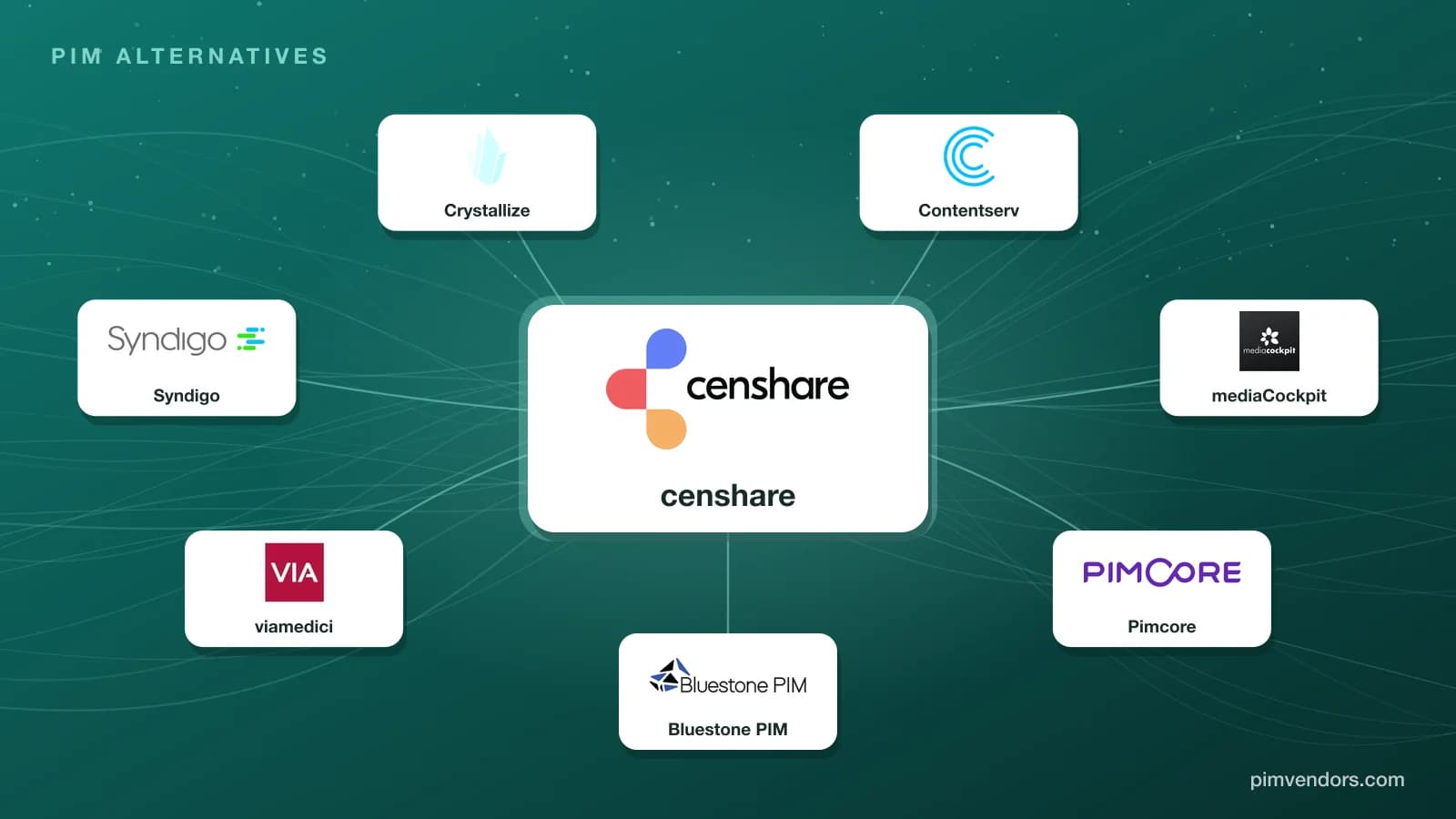
censhare sits on shortlists where product information is one part of a larger content operation: catalogs, campaigns and brand content in many languages. Teams that run it reopen the decision at a renewal, when the commerce stack changes, or when they find they use only part of the platform. This guide covers what censhare does, why teams compare it, seven alternatives ordered by how close they sit to censhare's buyers, and how to switch.
What censhare is and who it fits
censhare is a German software company, founded in 2001. Its platform unifies PIM, DAM and content management on a semantic, graph-based database, and runs as SaaS, cloud-hosted or on-premise. It aims at mid-market and especially enterprise companies in retail, manufacturing, media and publishing, and its users are mostly marketing, brand and content operations teams. It covers:
- Native DAM: a core module, with AI tagging and deep relations between assets and products.
- Product data: a product and product item matrix, product sets for packaged units, and accessories through relations.
- Workflows and quality gates: configurable workflows, completeness checks and a syndication preview.
- Localization and cross-media publishing: translation memory and publishing to print and digital from the same content.
- Integrations: SAP, Magento, Salesforce Commerce Cloud, priint:suite, SDL Trados and Adobe Experience Manager, plus an open API.
| System | What it owns | Who works in it | The question it answers |
|---|---|---|---|
| PIMProduct information managementPIM guide | Sellable product content: attributes, descriptions, asset links, translations and channel versions. | E-commerce, marketing, category and product content teams. | Is this product complete and ready to sell on this channel? |
| DAMDigital asset managementDAM guide | Files and media: images, video, documents, renditions and usage rights. | Brand, creative and marketing teams. | Where is the approved file, and where may we use it? |
| MDMMaster data managementMDM guide | Golden records across domains: customers, suppliers, locations and products, matched and governed. | Data governance, data stewards and IT. | Which version of this record is the true one, in every system? |
That is the first question in a search for a censhare alternative. If the DAM and content side carries the value, look for another platform that combines them. If you mainly use the product data side, the field of PIMs is much wider.
Why teams look for a censhare alternative
- Deployment effort, standards proof and commercial transparency. These are the three points to evaluate censhare against, and they often reopen the decision at renewal.
- The job is product data, not content operations. A team that uses censhare mainly to manage attributes and feed shops and marketplaces runs a content platform it only partly uses, and may be better served by a PIM-first system.
- Configurable products. A native engineering bill of materials or CPQ is not documented, and complex configurators are likely external. Manufacturers that want them in the same suite look elsewhere.
- A composable stack. Teams that move to a headless commerce architecture sometimes want an API-first PIM with a smaller scope next to their other services.
- Retailer compliance. Brands that sell through retailers with strict content rules may need a syndication network with GDSN.
censhare alternatives at a glance







| Alternatives to censhare | Built for | Industry | Runs as | Founded | Go-live (estimate) |
|---|---|---|---|---|---|
| Today: censhare | Mid-market, Enterprise | Retail, Manufacturing | SaaS, Cloud-hosted, On-premise | 2001 | 20 weeks |
| Contentserv | Mid-market, Enterprise | Manufacturing, Retail | SaaS, Cloud-hosted, On-premise | 2000 | 20 weeks |
| mediacockpit | Mid-market, Enterprise | Manufacturing, Retail | SaaS, Cloud-hosted, On-premise | 1996 | 20 weeks |
| Pimcore | Small business, Mid-market, Enterprise | Manufacturing, Retail | Open source, Cloud-hosted, On-premise | 2009 | 16 weeks |
| Bluestone PIM | Mid-market, Enterprise | Retail, Manufacturing | SaaS, Cloud-hosted | 2016 | 20 weeks |
| Viamedici | Mid-market, Enterprise | Manufacturing, Wholesale | SaaS, Cloud-hosted, On-premise | 1999 | 20 weeks |
| Syndigo | Mid-market, Enterprise | Retail, Manufacturing | SaaS, Cloud-hosted | 1973 | 20 weeks |
| Crystallize | Small business, Mid-market, Enterprise | Retail | SaaS, Cloud-hosted | 2017 | 16 weeks |
- Contentserv: best for PIM and DAM in one suite, with supplier onboarding and high-volume feed syndication.
- mediacockpit: best for PIM, DAM and print publishing close together, with ETIM and ECLASS for B2B.
- Pimcore: best for one extensible, open-core platform for product data, assets and web content.
- Bluestone PIM: best for a composable, API-first PIM with a native DAM.
- Viamedici: best for SAP-centric manufacturers with configurable products and print catalogs.
- Syndigo: best for brands that need retailer syndication, validation and GDSN.
- Crystallize: best for mid-market digital teams that want product, content and commerce in one headless backend.
The alternatives
Founding years, headquarters and the fit and watch-out notes come from each system's vendor profile.
Contentserv
Contentserv, founded in 2000 with headquarters in Switzerland and Germany, combines PIM, DAM and master data patterns for product data in one suite, sold as SaaS, cloud-hosted or on-premise to mid-market and enterprise manufacturers, brands and retailers.
Of the options here it is the closest to censhare's PIM-plus-DAM model, with more weight on the product side: supplier onboarding with golden-record patterns, industrial classification and high-volume feed syndication through Shoppingfeed. Print runs through an established publishing partner.
Check: in February 2025 Centric Software, the PLM vendor owned by Dassault Systèmes, announced it would acquire Contentserv, so clarify the roadmap and support continuity. Treat ETIM and GS1 publication as a paid app or partner work unless a proof of concept shows otherwise. See also our Centric PXM alternatives.
mediacockpit
mediacockpit is a German PIM, DAM and publishing system from Bertsch Innovation, in business since 1996, for mid-market and enterprise manufacturers, retailers and publishers. It runs as SaaS, cloud-hosted or on-premise.
It is the closest match for censhare users who rely on print. It offers a print path through mediapublisher and priint, deep ETIM and ECLASS support with BMEcat for B2B, and GDSN through a partner.
Check: it is not a lightweight composable PIM, API documentation is gated, and marketplace syndication is narrower than in feed-first tools. Licensing is quote-based and rollouts are usually led by configuration and an integrator. Let your content team test the interface.
Pimcore
Pimcore is an Austrian open-core platform, founded in 2009, that combines product data, digital assets and content (CMS and portals) in one data layer. It runs open source, cloud-hosted or on-premise.
Its scope is close to censhare's: PIM, DAM and web content on one platform. The difference is the model. Pimcore is open-core, so your architects can inspect the code and you control the hosting, and it expands in modules toward MDM and commerce.
Check: open-core is not free at enterprise scale. Check the licence thresholds, audits and which features need the paid Enterprise edition, plan for a technical team or integrator, and ask for paid PIM references in your own sector.
Bluestone PIM
Bluestone PIM is a Norwegian SaaS PIM, founded in 2016, built on microservices with an API-only architecture, for mid-market and enterprise manufacturers, distributors and retailers.
It fits teams that use censhare mainly for product data and want to move to a composable stack. Its native DAM covers images, video, documents and 3D, with a PDF generator, and AI tools help with enrichment and translation. Web content and campaign material would live in other systems.
Check: deployment effort, proof of standards support and the commercial terms. Compare its DAM with your brand asset needs before you retire the censhare DAM.
Viamedici
Viamedici is a German enterprise suite, founded in 1999, that combines PIM, multidomain MDM, DAM, an integrated configurator and CPQ, and catalog publishing. It runs as SaaS, cloud-hosted or on-premise.
It covers the gap censhare leaves open for manufacturers: configurable products. It fits SAP-centric manufacturers and industrial distributors that need multi-language print and digital catalogs, ETIM and ECLASS, and governed master data outside SAP.
Check: it is not a lean composable PIM, so budget for suite complexity and integrator cost. Evidence for GDSN and GS1 retail syndication is thin.
Syndigo
Syndigo is a US platform that combines PIM, MDM, DAM and content syndication with a network of retailers, and it is a certified GDSN data pool.
It fits censhare users in consumer goods and retail whose main problem is getting validated content, including enhanced product page content, to each retailer's requirements. Its best fit is with enterprise teams in consumer goods, foodservice, health and beauty and hardlines.
Check: authoring and composable APIs are secondary to network compliance, and the content hub and the Riversand MDM are two integration surfaces. It does not take over censhare's role for web content and marketing material.
Crystallize
Crystallize is a Norwegian headless commerce backend with PIM, founded in 2017, that combines product data, content and commerce behind a GraphQL API, for small and mid-market teams.
It fits a narrow but real case: a mid-market digital team that uses censhare for product data and web content and wants both in one headless backend behind its own storefront. It does not replace censhare's DAM depth or print publishing.
Check: it needs engineering capacity, it is not built for ERP-centric catalog operations, and it has no native GDSN, ETIM or marketplace syndication.
How to choose and switch
Map what censhare does for you
Split it into product data, assets, web and marketing content, print and translation, and note who uses each part and how often. This shows which part carries the value.
Decide on one platform or several
Either replace censhare with another platform that combines PIM and DAM, or split the jobs over a PIM, a DAM and a CMS. This decision sets the shortlist.
Demo with your own data
Give each vendor one product family with its assets, one print output and two languages. Let the content and product teams score the work.
Migrate assets with their relations
Move files together with their metadata, rights and links to products, and rebuild print templates and integrations. Migrate one product family or market at a time with a parallel run.
Switch censhare off last
Only when every channel, print process and translation flow runs from the new setup. Plan the end of the contract around that date.
Compare more systems
Compare these and other systems in the PIM profile overview, or get a free shortlist based on your scale, sector and must-haves with the PIM Scan.
- What are DAM and PIM systems: what each one owns and how they connect.
- Contentserv alternatives: more PIM and DAM suites.
- How to select the right PIM: the full selection method.
Where to go from here
Frequently asked questions
What is censhare?
censhare is a German software company, founded in 2001, whose platform unifies PIM, DAM and content management in one system on a semantic, graph-based database. It runs as SaaS, cloud-hosted or on-premise and serves mid-market and enterprise companies in retail, manufacturing, media and publishing.
Is censhare a PIM or a DAM?
Both, plus content management. The DAM is a core module, and the PIM side covers product and product item structures, workflows and completeness checks. That suits organizations whose product information is part of a larger content operation with catalogs, campaigns and many languages.
What are the best censhare alternatives?
For PIM and DAM in one suite, Contentserv and mediacockpit. For one open-core platform for product data, assets and content, Pimcore. For a composable PIM, Bluestone PIM. For configurable products in an SAP landscape, Viamedici. For retailer syndication and GDSN, Syndigo. For a headless backend for a mid-market team, Crystallize.
What does censhare integrate with?
Its integrations include SAP, Magento, Salesforce Commerce Cloud, priint:suite for print, SDL Trados for translation and Adobe Experience Manager, plus an open API. Confirm the exact connectors and versions you need during shortlisting, and ask every alternative for the same list.
Which censhare alternative is best for print catalogs?
mediacockpit, with print through mediapublisher and priint, and Viamedici, with template-driven catalog creation through InDesign. Contentserv handles print through an established publishing partner. Test a real catalog page in the demo, not a slide.
Does censhare support configurable products?
A native engineering bill of materials or CPQ is not documented, and complex configurators are likely to sit outside censhare. If you need them in the same suite, compare Viamedici, which includes a configurator and CPQ.
Is censhare suitable for the mid-market?
censhare serves mid-market and enterprise companies, but it aims first at enterprises with complex content operations. A mid-market team that mainly needs product data for its shop and marketplaces may be better served by a PIM-first system.
How do you migrate away from censhare?
Map what censhare does for you today (product data, assets, web content, print and translation), decide whether one platform or several take over, export assets with their metadata and relations, rebuild print templates and integrations, migrate in slices with a parallel run, and switch censhare off last.
Diagnostic
Do you actually need a PIM?
Run the complexity index before you budget software or hire an SI.
Budget
Model a first-pass TCO
Translate catalog shape into a three-year cost range in under ten minutes.